AI search is evolving faster than ever.
Since 2025, I’ve tracked and analyzed virtually every major study, experiment, and industry report on AI search, including research from Ahrefs, Semrush, Similarweb, SparkToro, Seer Interactive, Google, Kevin Indig, and dozens of independent experts.
This article distills that research into the statistics and insights that matter most for marketers, SEOs, and content teams in 2026.
If you’re looking for the complete dataset, you can access our AI Search Report containing 250+ AI SEO statistics, studies, and experiments.
Methodology
This article contains the most important statistics and insights from 250+ third party GEO studies + our own research.
Rather than compiling every available statistic, I’ve selected the findings that best explain where AI search is heading and what they mean for SEO in 2026.
The goal is to help you quickly understand the trends that are shaping search—and the strategies most likely to matter going forward.
Key AI SEO Insights for 2026
- AI is emerging as a major search channel. Search-related usage of AI (asking prompts) is 28% the size of search worldwide.
- But Google is still the largest search engine with over 5 billion users globally, processing an estimated 16.4 billion searches per day.
- AI isn’t replacing Google — it expands search. Total usage of search combining search engines and search on LLMs has increased by 26% worldwide.
- AI adoption is growing, but fragmented. More and more people (especially GenZ) are losing trust in the accuracy and credibility of AI answers.
- Consumers and B2B professionals use AI to research brands and products or services. But they still validate the information and make the actual purchase using search engines.
- AI Overviews reduce 58% of clicks to top-ranking pages. Users now stay longer on the SERP reading the AI summaries instead of clicking search results.
- AI recommendations influence buying decisions. The AI’s top pick becomes the user’s top pick 74% of the time.
- LLM mentions also drive more direct traffic. Brands appearing in ChatGPT recommendations were 2.5x more likely to receive a site visit within 7 days.
- AI traffic remains small, but it’s growing fast. Visitors coming from AI are also more engaged and more likely to convert than standard web visitors.
- Top LLM ranking factors: offsite presence and domain authority, user trust signals, topical coverage, technical health, and content freshness.
Is AI Replacing Google?
AI chatbots like ChatGPT, Perplexity, and Gemini are becoming popular search channel alternatives, especially for ultra-long and super-specific queries.
But interestingly, according to recent data, people haven’t abandoned Google just yet.
AI is emerging as a major search channel
More and more people are using AI to search for information.
- Around 3 in 4 American respondents say they search with AI weekly. Their top use cases include quick facts, shopping research and health information. (Mango Thrive, March 2026)
- Monthly sessions of AI are now 56% the size of search worldwide (34% in the US). Search-related usage of AI (asking prompts) is 28% the size of search worldwide (17% in the US). (Graphite, March 2026)
- Google’s AI Overview has reached 2.5 billion users, while AI Mode has surpassed 1 billion monthly users. (Google, June, 2026)
- ChatGPT has just crossed 1 billion active users in May 2026, making it the fastest growing mobile app ever. (SensorTower, June 2026)
- ChatGPT now accounts for 20% of search-related traffic worldwide and 12% in the US. (Graphite, March 2026)
But Google is still the dominant search engine
Google is still the largest search engine by a wide margin. Abandoning SEO and focusing solely on AI search optimization isn’t the smart move.
- Organic traffic from Google to websites is down slightly (-2.5% YoY), not dramatically. (Graphite, January 2026)
- Google is still the most popular search engine with over 5 billion users globally, processing an estimated 16.4 billion searches per day. (Demandsage, May 2026)
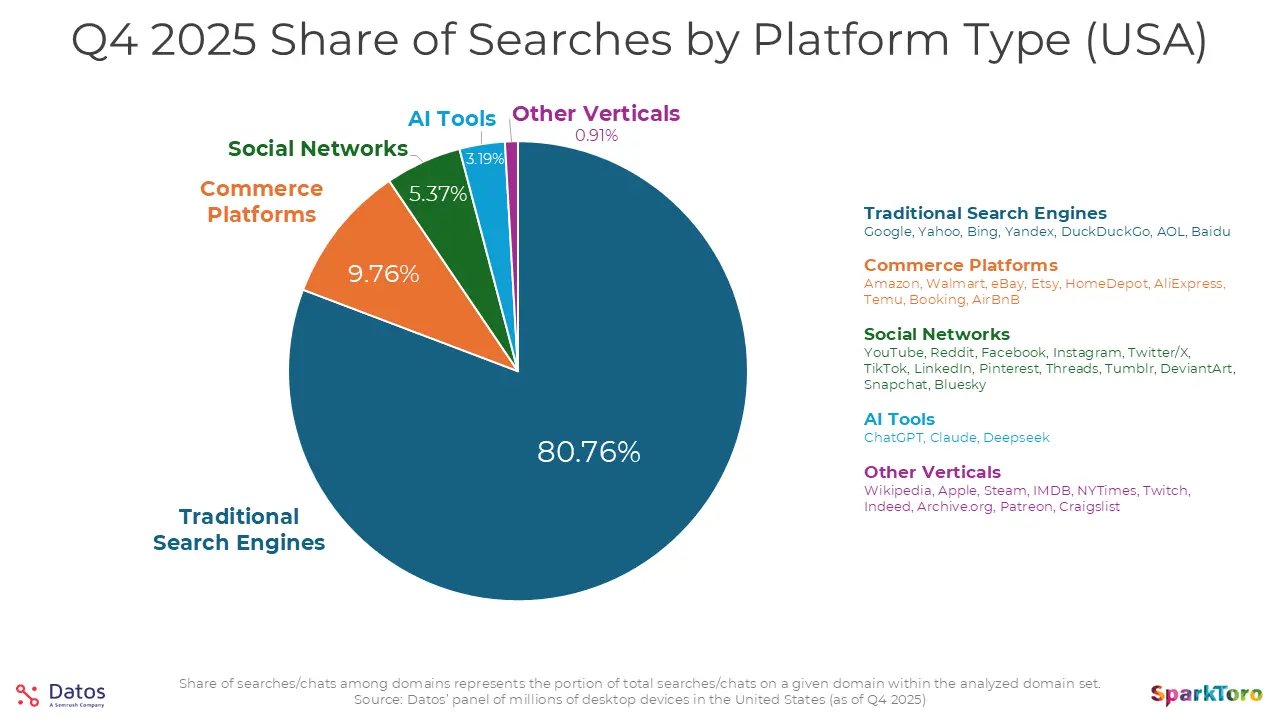
- Google alone was responsible for 73.7% of all desktop searches in the US. AI tools only make up 3.2%. (Sparktoro, March 2026)
AI isn’t replacing Google; it’s expanding search
Traditional search has not decreased. Instead, the pie has gotten bigger, as people use both search engines and AI platforms to find information.
- The average Google Search usage went up to 12.6 sessions per week after people began using ChatGPT, compared to 10.5 weekly sessions before ChatGPT adoption. (Semrush, August 2025)
- Total usage of search combining search engines and search on LLMs has increased by 26% worldwide and by 16% in the US. (Graphite, March 2026)
- 61% of B2B software buyers use AI search engines alongside Google in tandem. (G2, April 2026)
AI Adoption is Growing, But Fragmented
AI adoption is growing, but trust remains mixed.
More consumers are using AI for search, yet confidence in its accuracy has declined as people gain experience with the technology.
- Consumers are using AI more: 70% of consumers say their AI use for search has increased over the past year. Only 4% have never used AI tools for search at all. (Fractl, July 2026)
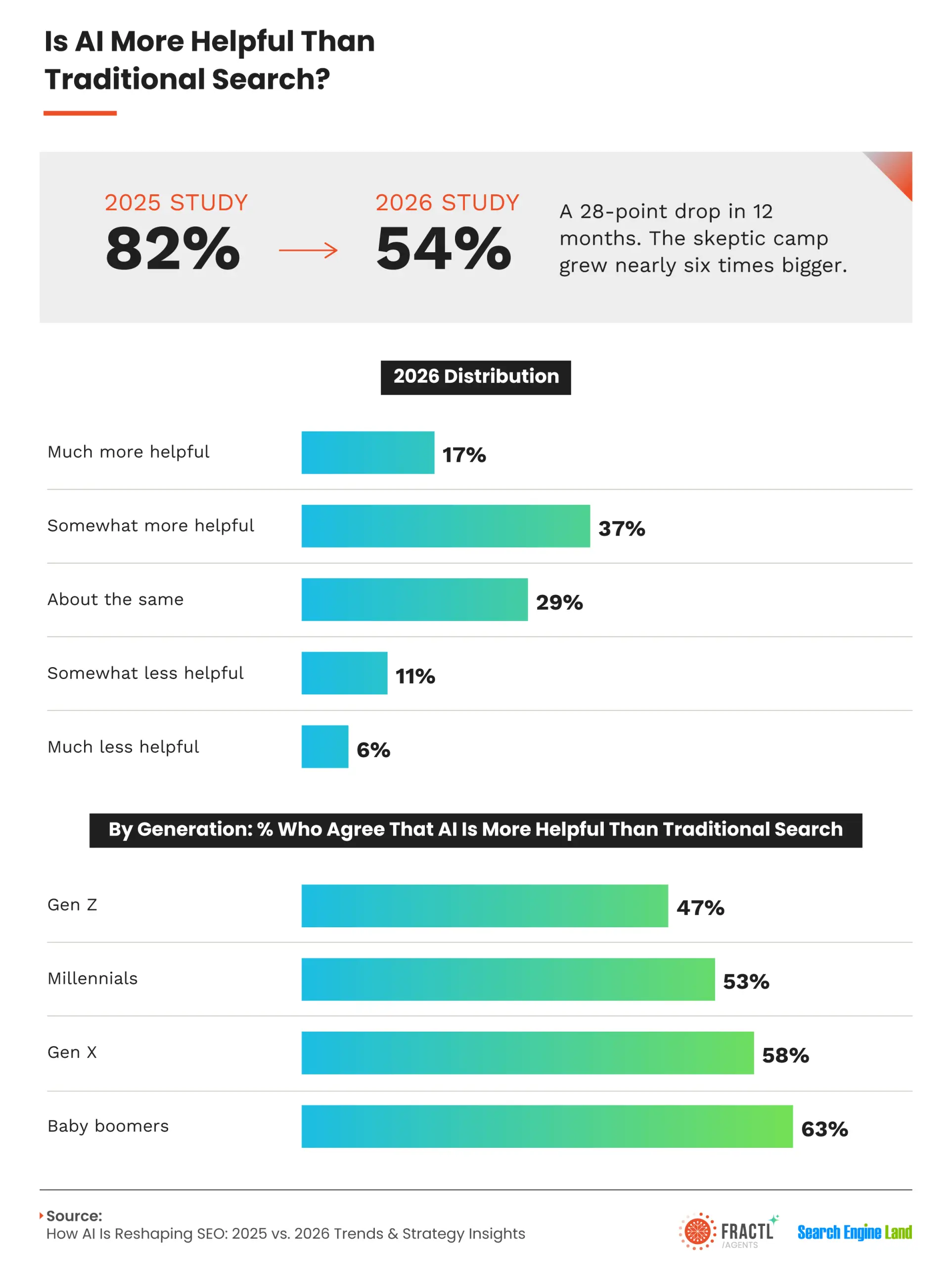
- But they trust AI less. In 2025, 82% of consumers said AI was more helpful than traditional search. In 2026, that number dropped to 54%. (Fractl, July 2026)
- Baby Boomers (63%) are more likely than Gen Z (47%) to find AI helpful. This actually makes sense: Gen Z uses AI search the most. So they’re going to catch more mistakes than boomers. (Fractl, July 2026)
Top LLMs Based on Active Users
ChatGPT is still the category leader. The ChatGPT app has recently crossed the 1 billion user mark in May 2026, becoming the fastest ever mobile app to do so.
But Gemini is catching up fast. The Gemini app now has 950 million monthly active users, according to CEO Sundar Pichai in Alphabet’s second-quarter results in July, 2026.
| AI platform | Est. active users | Monthly web visits |
| ChatGPT | 1 billion | 5.32 billion |
| Gemini | 950 million | 1.14 billion |
| Perplexity | 45 million | 140.7 million |
| Copilot | 20-33 million | 93 million |
| Claude | 18.9 million | 968 million |
How Do People Use Search and AI Engines?
AI is very helpful for researching a new topic, comparing products or services, and building a vendor shortlist quickly.
But consumers are still using search engines to validate the information they get from AI answers and make the actual purchase.
Users are asking longer questions in AI compared to traditional search
Users are searching differently in AI. Queries are becoming longer, more natural, and more conversational, often including context and multiple follow-up questions.
- The average AI Mode query is 3x longer than a traditional search query. Instead of typing a few keywords, users are now asking detailed questions, adding context, refining their requests, and following up with additional prompts. (Google, May 2026)
- 65%–85% of ChatGPT prompts have no matching keyword in its keyword database. In other words, most AI prompts represent entirely new ways people seek information—long, conversational requests that traditional SEO tools were never designed to capture. (Semrush, April 2026)
Buyers increasingly use AI to research new brands and products
Many consumers and B2B professionals now begin their buying journey with AI.
- Among all adults, 42% use chatbots to gather information, while 38% of employed adults use them for work tasks. (Pew via Search Engine Journal, June 2026)
- 51% of B2B software buyers now start their research with an AI chatbot more often than with Google. (G2, April 2026)
- 66% of B2B professionals use AI to research vendors and software solutions. (Semrush, July 2026)
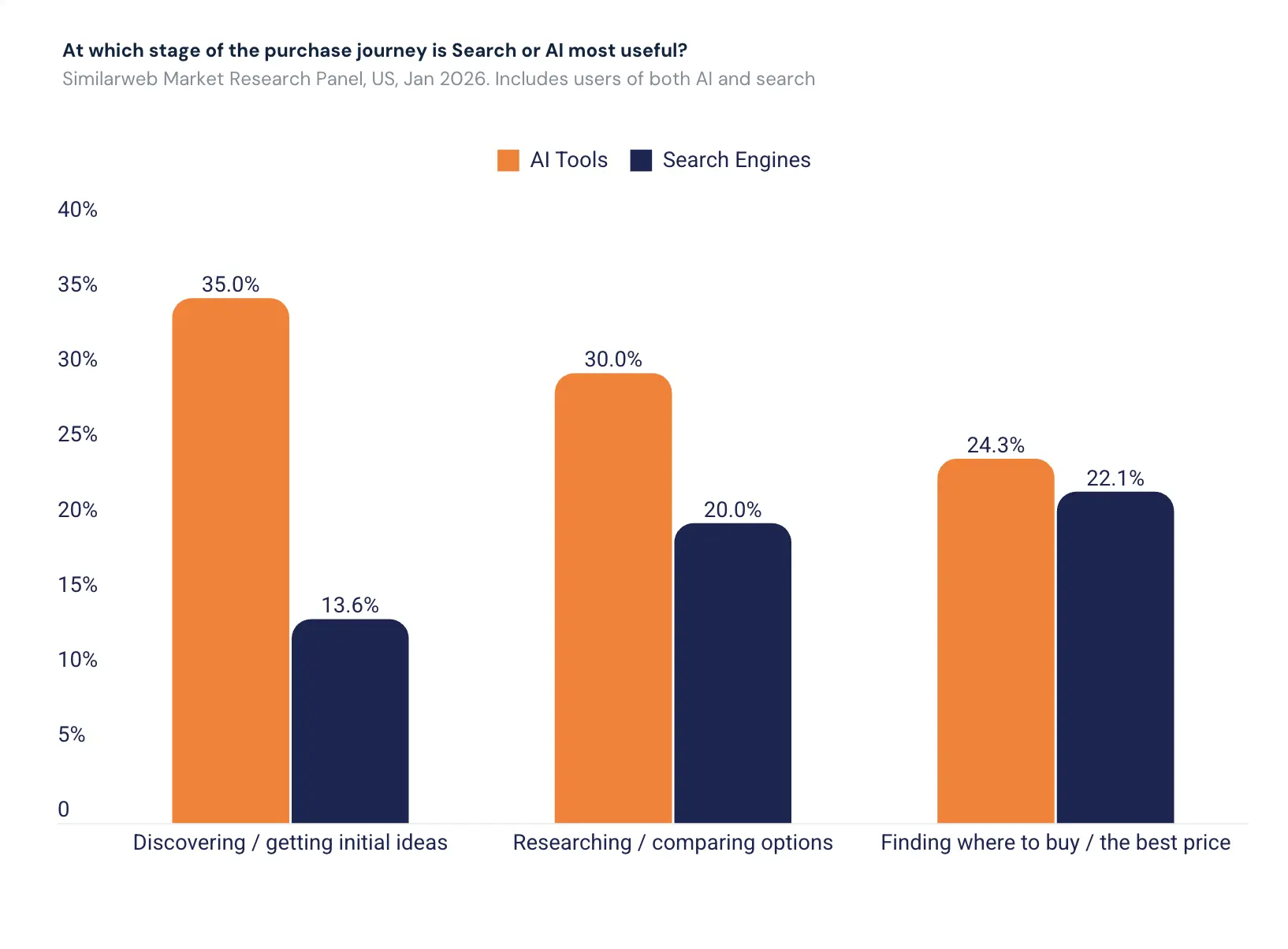
- 35% of users said AI is more useful than search engines for discovering new brands, while only 13.6% preferred traditional search. (Similarweb, June 2026)
- 30% of users preferred AI for evaluating products or services, compared to 20% who preferred search engines. (Similarweb, June 2026)
But users still turn to search engines for fact checking and transactions
Users rely on AI to explore, but they still turn to search engines for researching high-stakes topics, verifying information, and completing purchases.
- After getting a recommendation, 62% immediately search Google, while 58% visit the business’s website directly. (Yext, April 2026)
- A survey by NN Group revealed that people use AI to explore and synthesize information, but they still rely on traditional search to double check fact accuracy. (NN Group, February 2026)
- 57% of users still prefer traditional search for important YMYL (Your Money Your Life) topics, like health and finance. (Yext, April 2026)
- When users are ready to buy, 22.1% found traditional search useful, while 24.3% preferred AI. This suggests people still rely on search engines for local availability, pricing, and transactions. (Similarweb, June 2026)
AI Overviews Change User Behavior on SERPs
We’re in the era of zero-click searches. AI Overviews allow users to find answers without leaving Google, reducing clicks to organic search results.
AI Overviews reduce clicks to websites
As Google answers more questions directly on the top of the results page, fewer users need to visit websites at all.
- 68.01% of Google searches ended without a click. (SparkToro, June 2026)
- AI Overviews now reduce clicks by 58% for the top-ranking page. (Ahrefs, February 2026)
- Organic CTR dropped 61% for queries where an AI Overview is present. (Seer Interactive, November 2025)
Users now read AI Overviews before clicking
AI Overviews are keeping users on the search results page longer. Users spend more time reading AI summaries and less time clicking through to websites.
- About 60% of U.S. adults say they read AI summaries at the top of search engine results, while about 30% say they don’t, and 10% are unsure. (Pew via Search Engine Journal, June 2026)
- Users kept their cursor still 44% of the time when an AI Overview was present, compared to 29% without one. Instead of immediately clicking, people paused to read, compare information, and reconsider their next step. (Growth Memo, May 2026)
- Time-on-page clustered around 21 seconds whenever an AI Overview appeared. This behavior was consistent across every search intent. Whether users were looking for information, local businesses, products, videos, or specific websites. (Growth Memo, May 2026)
- Users engage with search results and AI Overviews the most on SERPs. Both received 100% of user attention and click-through rates of 95.5% and 86.4%, respectively. (Laika, July 2026)
The Impact of AI Mentions & Citations
Everyone wants to increase their brand mentions and citations in AI answers. But what impact do they actually bring to your business?
AI recommendations influence buying decisions
As more buyers rely on AI to evaluate options, the recommendations they receive increasingly shape which brands they consider and ultimately choose.
- AI is building the SaaS shortlist: 85% of buyers think more highly of a software vendor when AI includes them in an answer. (G2, April 2026)
- In classic search, 56% of users built their own shortlist from multiple sources. In AI Mode, 88% of users took the AI’s shortlist without external check. (Growth Memo, April 2026)
- The AI’s top pick becomes the user’s top pick 74% of the time. Only 10% chose something ranked third or lower. (Growth Memo, April 2026)
- 26% of AI Mode users overrode rank order due to brand recognition. They spotted a brand lower on the list and preferred it regardless of where the AI placed it. (Growth Memo, April 2026)
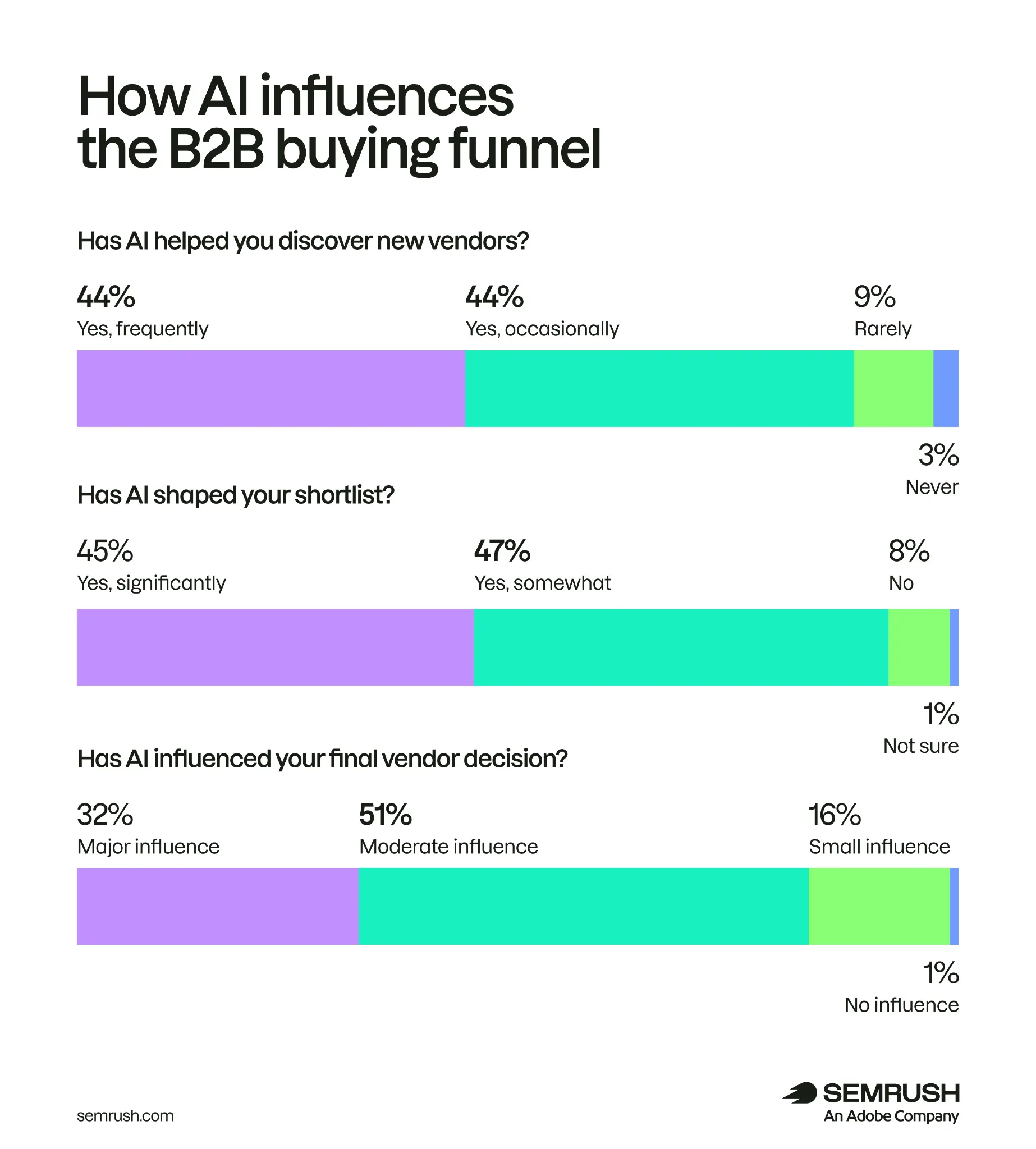
- 92% of B2B software buyers said AI influenced their vendor shortlist, with 45% saying it had a significant impact. (Semrush, July 2026)
AI mentions and citations drive more traffic
AI mentions don’t just influence consideration—they also generate website visits.
Users can click directly on cited sources within AI responses.
Repeated exposure to a brand in AI answers can also increase awareness and often leads people to visit the brand’s website later through direct navigation or branded searches.
- Organic CTR is 35% higher when your brand is cited inside an AI Overview. (Seer Interactive, November 2025)
- After getting a recommendation, 52% of users click through to sources cited in the AI response. (Yext, April 2026)
- Brands appearing in ChatGPT recommendations were 2.5x more likely to receive a site visit within 7 days than brands not recommended. (Similarweb, June 2026)
- User visits increase 1.5–2.5x within 7 days after an AI assistant (ChatGPT, Gemini, and AI Overviews) mentions a brand. (Profound, July 2026)
AI Referral Traffic is Small, But Highly Engaged
AI traffic remains small, but it’s growing fast. Visitors coming from AI are also more engaged and more likely to convert than standard web visitors.
- On average, traditional organic traffic accounted for 25% of all website traffic, while AI referral traffic accounted for just 1.08%. (Conductor, November 2025)
- For B2B SaaS companies, referral traffic from AI chats only makes up 1% of the total traffic, compared to 23.4% for organic search. (Position Digital, July 2026)
- But AI referral traffic has grown 9.9x in 19 months. 92.4% of it comes from ChatGPT alone. (Previsible, July 2026)
- Outbound referral traffic from ChatGPT to the rest of the web grew 206% in 2025. (Semrush, April 2026)
- AI-referral visitors are 2x more engaged than standard visitors. They view nearly twice as many pages and spend twice as long on site. (Similarweb, June 2026)
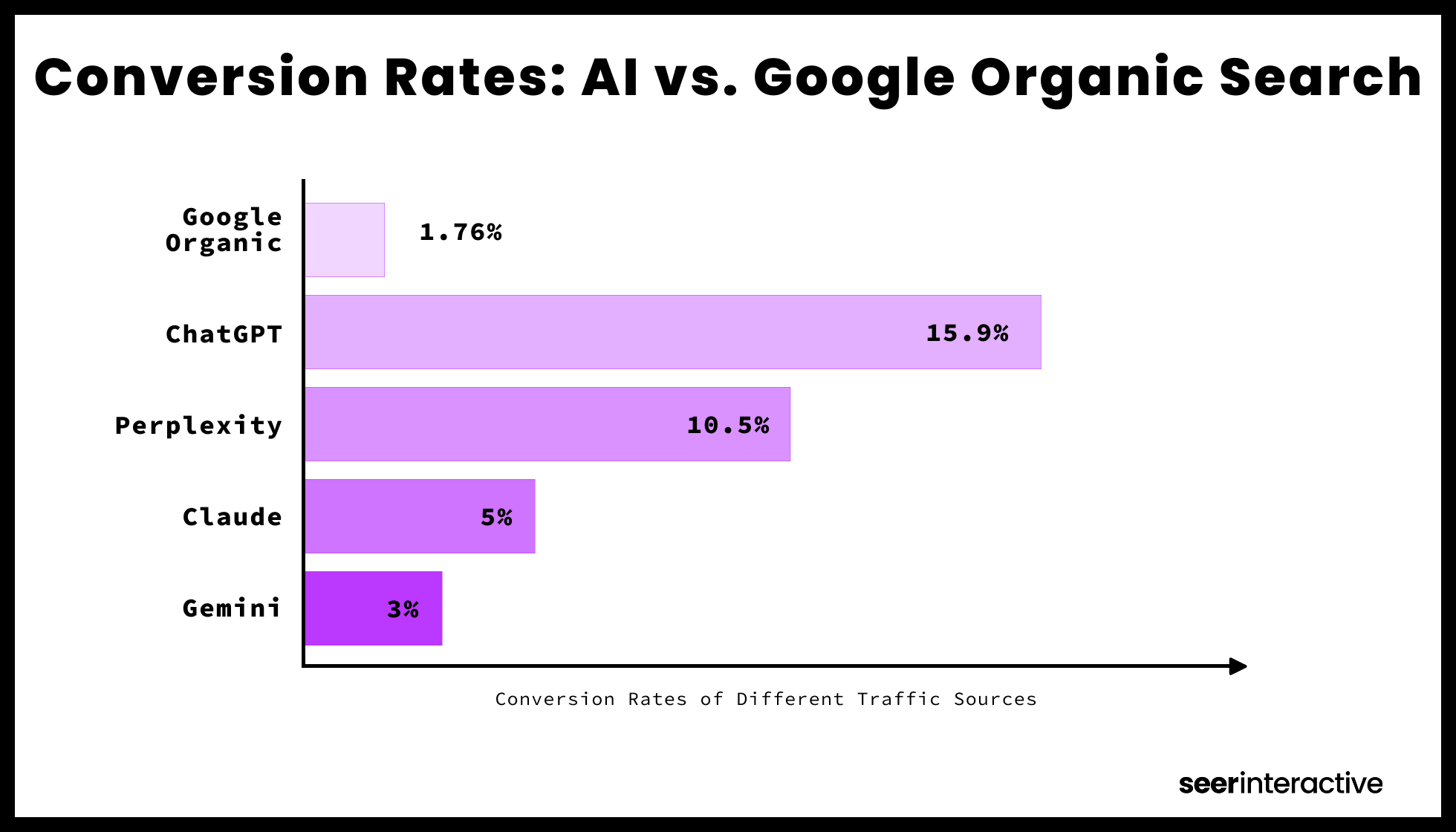
- LLM traffic has higher conversion rates than organic traffic: ChatGPT (15.9%), Perplexity (10.5%), Claude (5%), and Gemini (3%). Google’s organic conversion rate is 1.76%. (Seer Interactive, June 2025)
How do AI Platforms Cite Sources?
You know the importance of getting mentioned and cited by AI answers. But how do these platforms actually choose their sources?
Does organic performance impact AI visibility?
Yes, to an extent. Higher-ranking pages are more likely to be cited, but AI platforms increasingly surface relevant sources beyond Google’s top results.
- 43.2% of pages ranking #1 in Google is cited by ChatGPT. It’s 3.5 times higher than pages ranking outside of Google’s top 20. (AirOps, March 2026)
- 38% of AI Overview citations also rank in the top 10 of Google search results. (Ahrefs, March 2026)
- A page at position 1 has a 58% chance of being cited. By position 10, that drops to 14%. (Growth Memo, April 2026)
- Organic traffic is also a significant ranking factor. 37.1% of ChatGPT citations go to domains with over 100,000 monthly visits. (Position Digital, August 2026)
AI platforms cite source differently
Each AI platform has its own citation patterns. A page that’s frequently cited by one AI model may never appear in another.
That’s why optimizing for AI visibility requires platform-specific strategies.
- AI Overviews and AI Mode cite different sources: only 13.7% of citations overlap between the two Google AI features. (Ahrefs, December 2025)
- Only 2% of cited URLs appear across AI Overviews, ChatGPT, and Perplexity. 91% of citations appear only in one AI engine. (Growth Memo, May 2026)
How Google’s AI features pick their sources
Google’s AI features heavily rely on Google’s own ecosystem and trusted user-generated content from forums and social media.
- AI Mode mostly cites Google’s own properties like Google Business Profiles and Product Knowledge Panel cards. (Profound, July 2026)
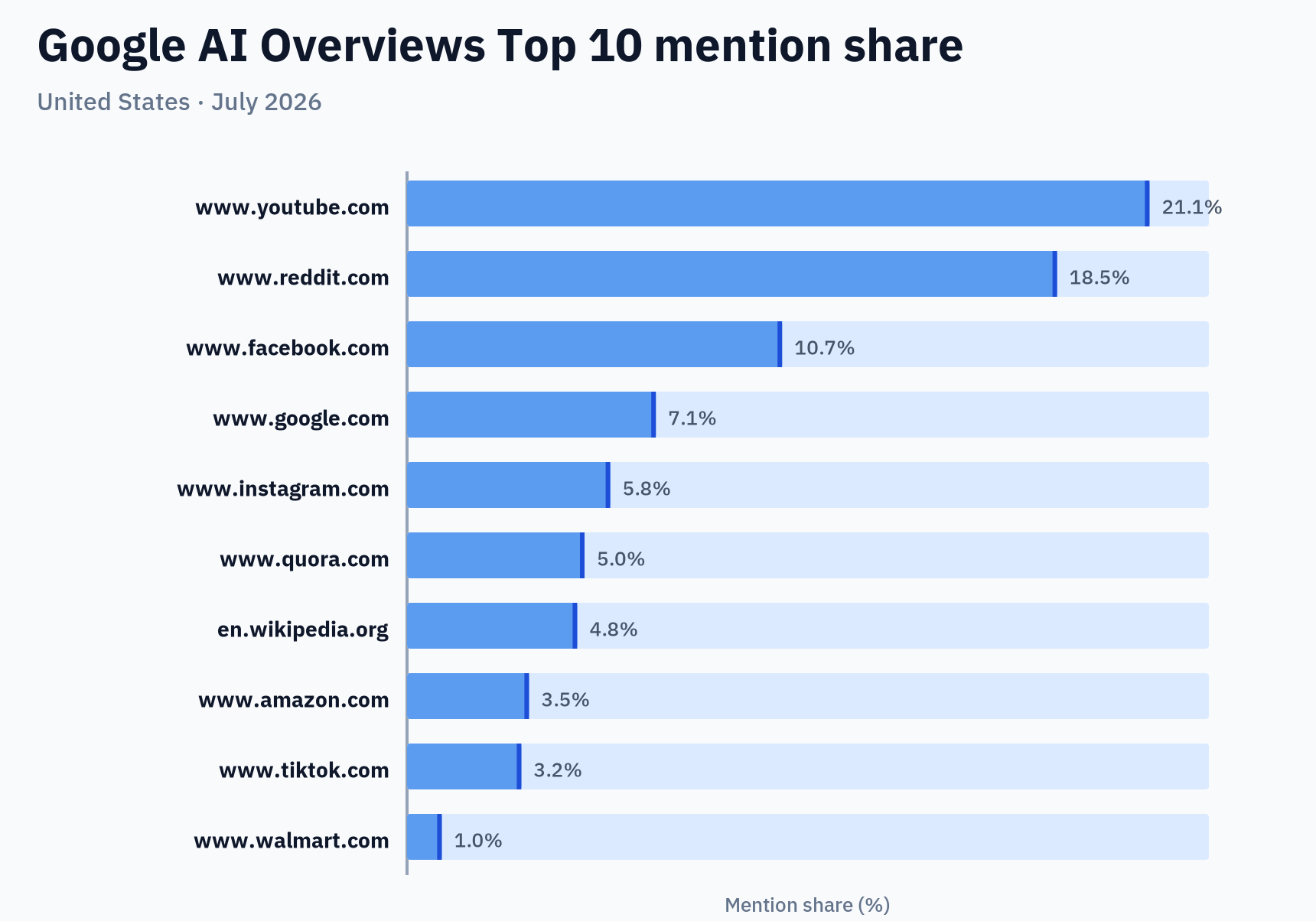
- YouTube is the most cited source in AI Overviews with a 21.1% mention share. (Ahrefs, July 2026).
- AI Overviews also love citing forums and social media platforms: Reddit (18.5%), Facebook (10.7%), Instagram (5.8%), and Quora (5%). (Ahrefs, July 2026).
How ChatGPT picks its sources
ChatGPT is currently placing a much stronger emphasis on official sources and authoritative information to fight against spammy and low-quality content.
- ChatGPT’s query fan-outs are now searching for “official” phrases such as “official site”, “official docs”, “official pricing”, and “official product”. (David Konitzny, July 2026)
- ChatGPT is increasingly fanning questions out into brand-specific sub-searches, hunting for names it already recognizes rather than just harvesting the open web. (Seer Interactive, July 2026)
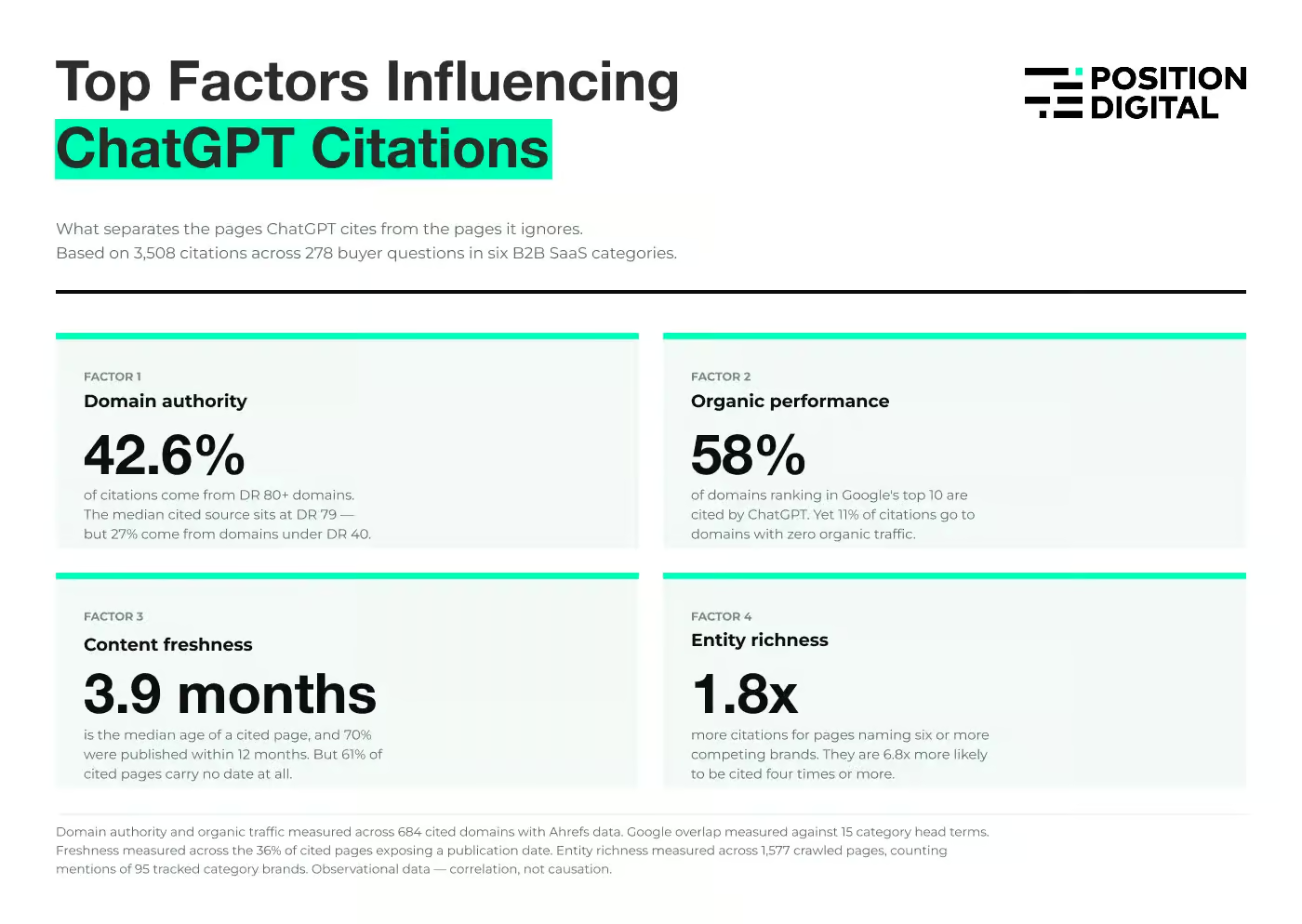
- Top factors that influence ChatGPT citations are domain authority, organic performance, content freshness, and entity richness. (Position Digital, August 2026)
- 42.6% of ChatGPT citations come from pages with a 80+ DR (Domain Rating). The median cited source sits at DR 79. (Position Digital, August 2026)
- Content freshness: among cited pages that expose a date, the median is 3.9 months old and 69.7% were published within 12 months. (Position Digital, August 2026)
- Entity richness: pages naming 6+ brands averaged 2.13 citations versus 1.21 for pages naming none. (Position Digital, August 2026)
The top cited domains across major AI platforms
Some websites are consistently cited across AI platforms. So, having a strong presence on these sites can really boost your AI visibility.
- G2 is the most cited software review platform on ChatGPT, Perplexity, and Google’s AI Overviews. (Radix)
- LinkedIn is the most-cited domain for professional queries in AI Overviews, AI Mode, ChatGPT, Microsoft Copilot, and Perplexity. (Profound, March 2026)
- YouTube and Reddit combined account for 78.2% of AI social media citations. YouTube was cited in 31.8% of cases, second only to Reddit at 46.4%. (OtterlyAI, April 2026)
Citations vs Mentions
Most LLM citations are “ghost citations.” The domain gets a source link but the brand name isn’t mentioned in the answer text.
- 66% of B2B SaaS brand recommendations happen without ChatGPT citing that brand’s website at all. (Position Digital, August 2026)
- 61.7% of LLM citations are ghost citations: the domain gets a source link but the brand name isn’t mentioned in the answer text. (Growth Memo, April 2026)
- Only 13.2% of appearances convert into both a citation and a mention (Growth Memo, April 2026)
- Gemini mentions brands in 83.7% of responses, but only generates a citation link 21.4% of the time. It operates more like a conversationalist drawing on brand knowledge. (Growth Memo, April 2026)
- ChatGPT is the opposite: It cites 87.0% of the time but mentions brands in only 20.7% of answers, functioning more like an academic paper with footnotes. (Growth Memo, April 2026)
- AI Mode is similar to ChatGPT: it cites sources 76.3% of the time but only mentions brand names 37.6% of the time. (Growth Memo, April 2026)
- AI Overviews show the closest percentages of mentions (61%) and citations (84.9%) out of the 4 major AI engines. (Growth Memo, April 2026)
- AI systems are using content aggregators and academic sites (Medium, Wikipedia, Wired, etc) as sources, but almost never mention them. (Growth Memo, April 2026)
- Conversely, popular consumer brands are named in the answer text even if they’re not cited as a source link. (Growth Memo, April 2026)
Which Factors Correlate With AI Citations?
AI platforms work differently than search engines. They use different algorithms and ranking factors to determine which brands to recommend, and which ones to ignore.
Based on various studies, can identify several factors that consistently influence AI visibility:
Offsite presence and domain authority
AI systems are more likely to find, trust, and cite brands that appear consistently across the web.
- Brands are 6.5x more likely to be cited through third-party sources than their own domains. (Airops, October 2025)
- YouTube mentions and branded web mentions are the top factors that correlate with AI brand visibility in ChatGPT, AI Mode, and AI Overviews. (Ahrefs, December 2025)
- 84% of AI citations come from earned media rather than your own website. (Muck Rack, May 2026)
- Earned media distribution can increase AI citations by a median lift of 239%. (Stacker, March 2026)
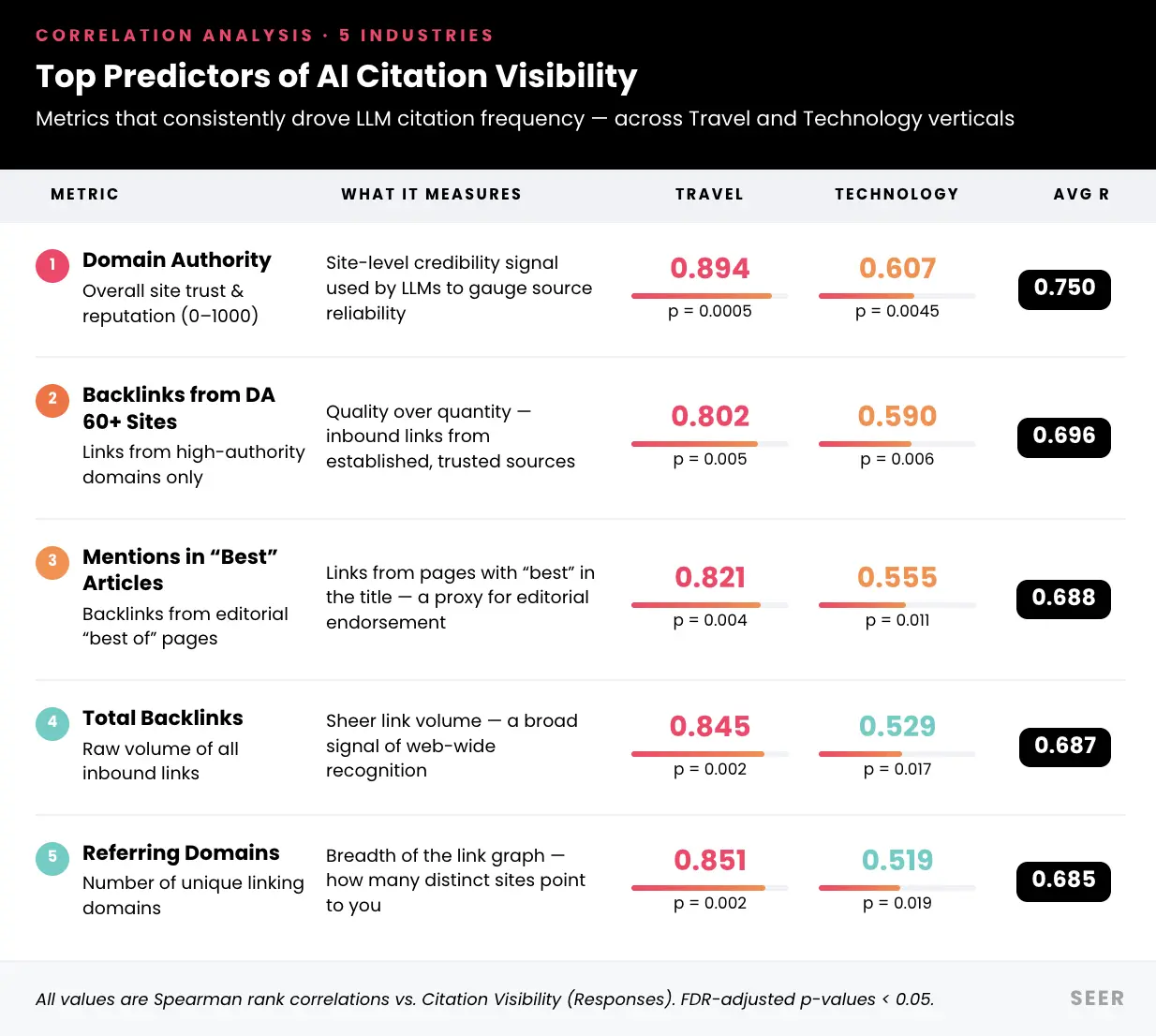
- Top 5 metrics that consistently drive LLM citations are domain authority, high-quality backlinks (from DA 60+ sites), mentions in “best” listicles, total number of backlinks, and unique referring domains. (Seer Interactive, March 2026)
User trust signals
AI platforms use reviews and third-party profiles as signals of brand credibility.
A strong presence on review platforms can significantly improve the chances of being selected as a source.
- Domains with profiles on platforms like Trustpilot, G2, Capterra, Sitejabber, and Yelp have 3x higher chances to be chosen by ChatGPT as a source, compared to sites without such presence. (SE Ranking, November 2025)
- Review profiles correlate with significantly higher AI citation rates across all platforms, verticals, and brand sizes. (Seer Interactive, May 2026)
- Brands with no Trustpilot profile have a median AI citation rate of 1%. Brands with even a minimal profile — as few as 1–13 reviews — jump to 53.5%. That’s a 52 percentage point swing. (Seer Interactive, May 2026)
- Brands with fully optimized Trustpilot profiles received 9.5x more co-mentions than T0 brands — meaning AI is recommending these brands when consumers are asking about someone else. (Seer Interactive, May 2026)
Topical coverage
AI platforms favor content that provides complete answers to user questions.
- Word count matters in ChatGPT visibility. Pages above 20,000 characters average 10.18 citations each vs. 2.39 for pages under 500 characters. (Growth Memo, March 2026)
- The top 4.8% of URLs in ChatGPT answers (cited 10+) are in-depth content that answers “what is it,” “who uses it,” “how to choose,” and “pricing” in a single URL. (Growth Memo, March 2026)
Technical health
Technical performance still matters for AI visibility. Fast, accessible, and well-optimized pages are easier for AI systems to process and cite.
- When done right, technical SEO audits and fixes can increase AI citations by 221% for a martech company. (Position Digital)
- Fast-loading pages are 3 times more likely to be cited by ChatGPT compared to slower ones. Pages with FCP under 0.4 seconds average 6.7 citations, while slower pages (over 1.13 seconds) drop to just 2.1. (SE Ranking, November 2025)
Content freshness
AI systems tend to favor recently updated sources, especially when answering queries where information changes frequently.
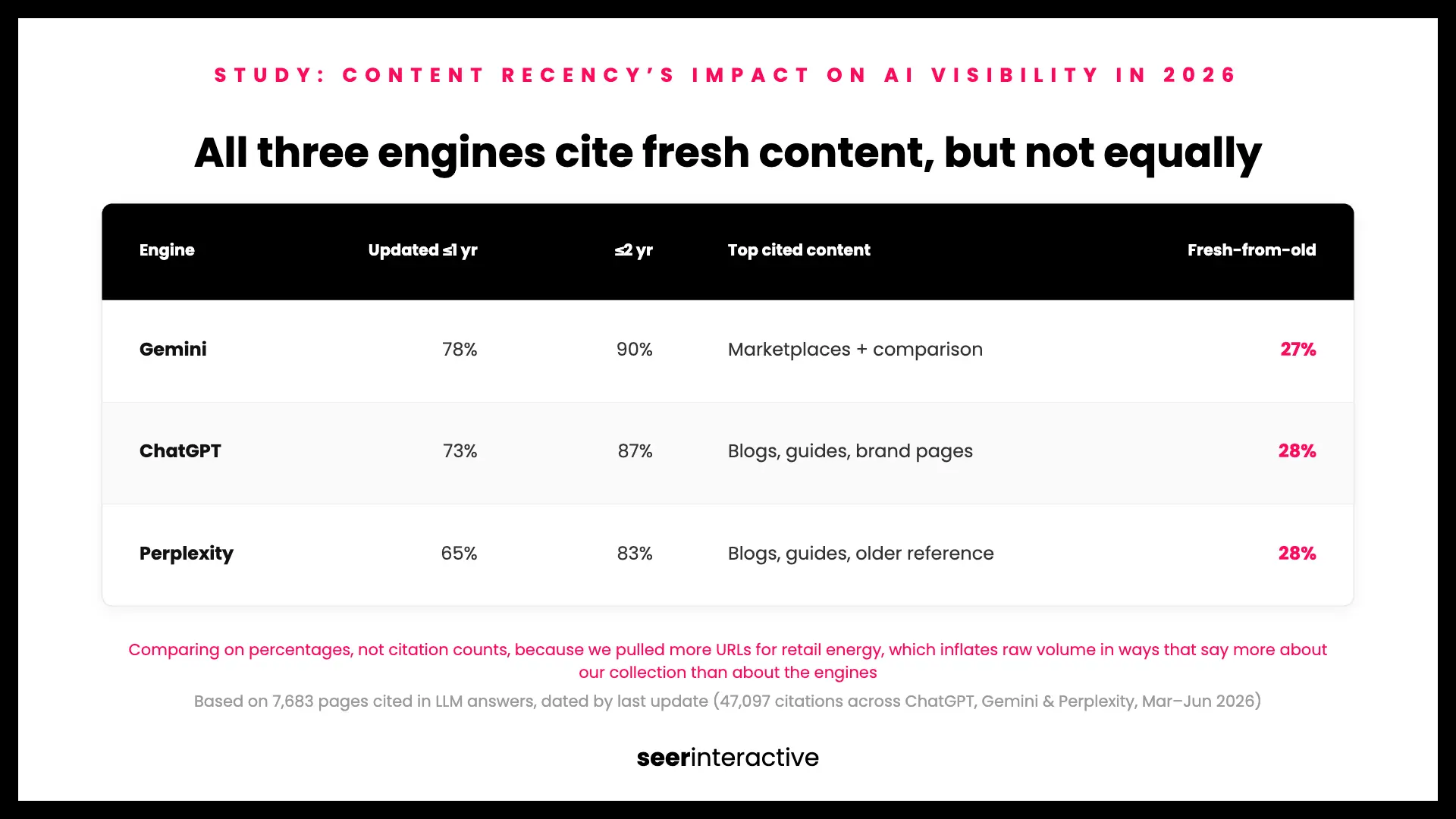
- 5% of the pages LLMs cite were updated in the last year. (Seer Interactive, July 2026)
- Gemini looks for fresh content the most: 78% of content cited updated in the last year, 90% updated within two years. (Seer Interactive, July 2026)
- ChatGPT sits in the middle: 73% updated in the last year, 87% within two years. (Seer Interactive, July 2026)
- Perplexity favors fresh content the least: only 65% updated in the last year, and 83% in the past two years. (Seer Interactive, July 2026)
Content That Wins in AI Search
Here are the content types and formats that AI platforms tend to favor.
Data-driven content
If you have original data or unique information that nobody else has, AI systems will have no choice but to cite your content.
- Primary research pages average 11.3 citations vs. 3.4 for non-primary pages — 3.3x more citation-dense. (Growth Memo, July 2026)
- But original data doesn’t automatically win you LLM citations; you still need to structure the content for AI extraction. (Growth Memo, July 2026)
- AI Overviews love factual statements: the typical AIO-cited article covers 62% more facts than the typical non-cited one. (SurferSEO, November 2025)
- Adding statistics and citations to your articles can boost AI visibility by 40%. (Pranjal Aggarwal et al, June 2024)
Bottom-funnel content
Listicles, comparison pages, and product pages among the most frequently cited content types in AI search.
- LLMs cite different content types for different intents. 45.48% of informational queries cite articles, while 40.86% of commercial queries cite listicles. (Wix, March 2026)
- Listicles (21.9%), articles (16.7%), and product pages (13.7%) are the most common citations in AI Mode, ChatGPT, and Perplexity. (Wix, March 2026)
- Versus pages (X vs Y), alternative pages, and “best X” listicles are page types that correlate the most with AI search traffic. (Siege Media, June 2026)
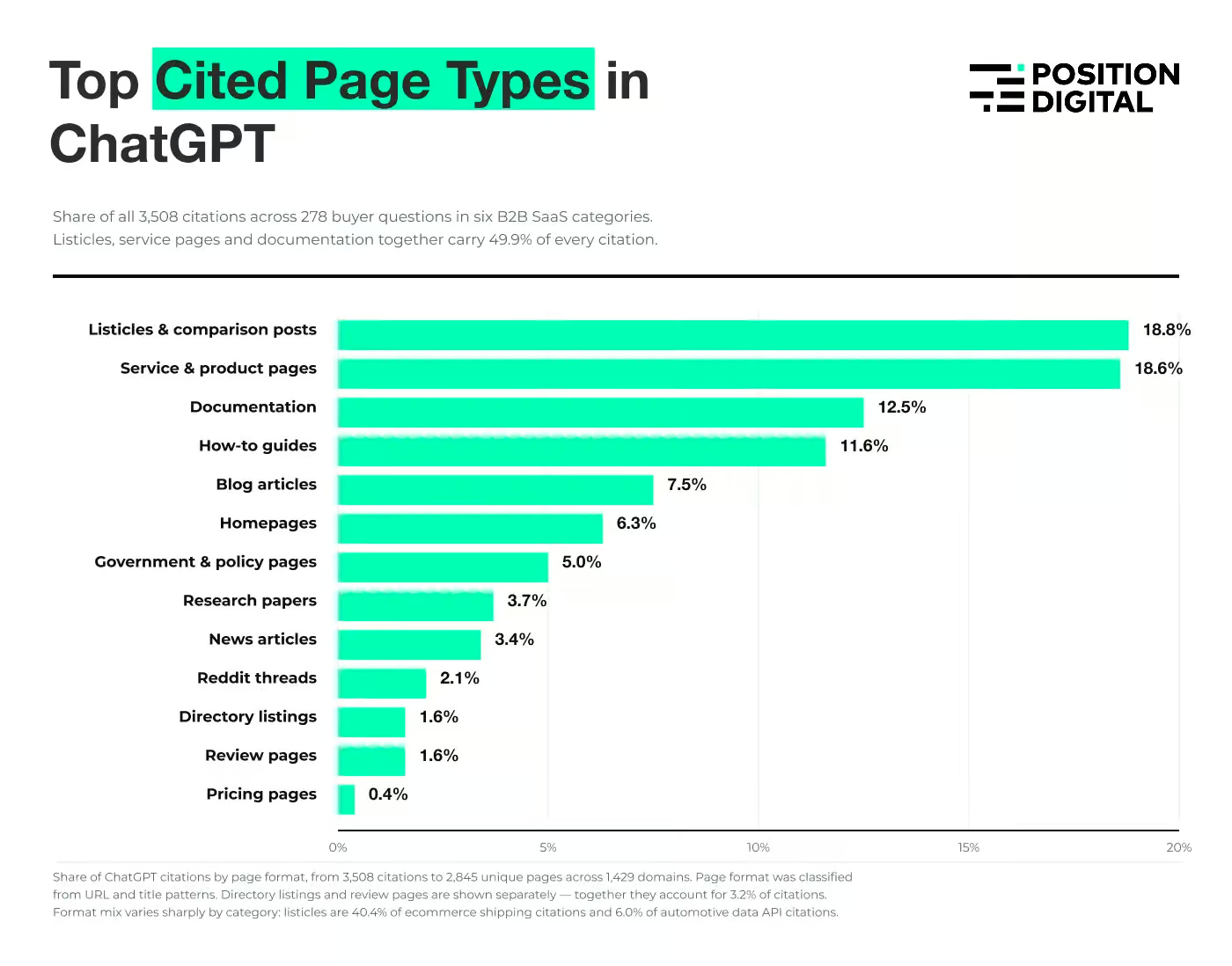
- For B2B SaaS, the most cited page types in ChatGPT are listicles (18.8%) and product/service pages (18.6%). (Position Digital, August 2026)
Well-structured content
AI systems need to quickly understand and extract key information. Clear structure, direct answers, and relevant headings improve the chances of being cited.
- 44.2% of all LLM citations come from the first 30% of text (the intro). 31.1% of citations come from the 30-70% of a text (the middle). 24.7% of citations come from the last third of an article (the conclusion). (Growth Memo, February 2026)
- Pages with headlines that directly answer the question get cited by ChatGPT 41% of the time. Pages with loosely related headlines drop to 29%. (Growth Memo, April 2026)
Which Factors Drive Brand Mentions in ChatGPT Answers?
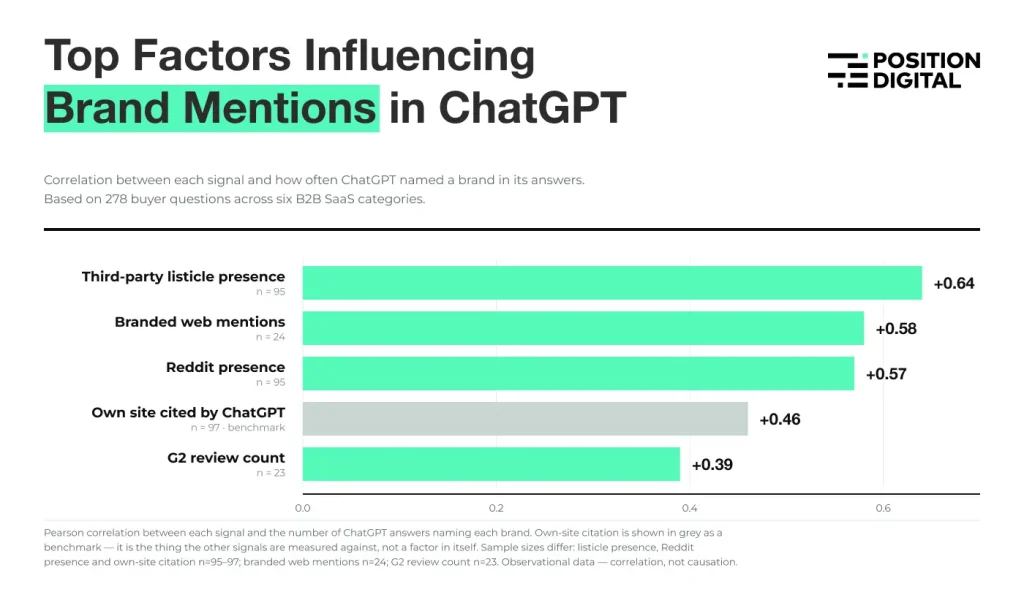
Based on our own analysis, here are the top two factors that influence ChatGPT recommendations, calculated using the Pearson correlation:
- Third-party listicle presence. Across 95 brands and 390 crawled listicles, the share of category listicles a brand appears in correlates with how often ChatGPT names it at r = +0.64. (Position Digital, August 2026)
- Branded web mentions. Web mentions correlate with ChatGPT recommendations at +0.58 on average. But volume alone doesn’t buy visibility; where you get mentions matter more. (Position Digital, August 2026)
- Reddit presence. the top 3 category leaders in each B2B SaaS niche appear in 22.6% of Reddit threads, compared to just 4.2% for everyone else. (Position Digital, August 2026)
- User review count. Brands with a stronger presence on G2 tended to appear more often in ChatGPT answers. However, the number of reviews mattered far more than the average rating. (Position Digital, August 2026)
AI Bot, AI Crawler & AI Agent Statistics
If you want to appear in AI answers, your content should be accessible to AI bots and crawlers.
And now, with the rise of agentic AI, technical optimization is even more important if you want to protect (and improve) conversions.
More and more sites are blocking LLM bots
As concerns around AI content scraping grows, more websites are restricting access to AI crawlers.
However, blocking AI bots does not always prevent a brand from appearing in AI-generated answers.
- 79% of major news publishers block AI training bots via robots.txt, including BBC, The New York Times, and The Guardian. (BuzzStream, December 2025)
- 71% of news publishers also block AI retrieval bots. (BuzzStream, December 2025)
- An analysis of 66.7 billion web crawlers found that LLM training bots are losing access, as more and more websites block them. (Hostinger, January 2026)
- In contrast, AI search bots continue to expand their reach on the web. (Hostinger, January 2026)
- But 75% of sites blocking OpenAI or Google AI bots still appeared in AI citations. (BuzzStream, April 2026)
Most of your traffic is coming from AI bots
LLM bots now drive a significant share of web traffic, more than Googlebot and human visitors.
- LLM bots (like ChatGPT and Perplexity) crawl websites much more frequently than traditional search engines (like Google and Bing). (Shannon Vize, January 2026)
- LLM bots now crawl 3.6x more than Googlebot. Those include ChatGPT-User, GPTBot, ClaudeBot, Amazonbot, Applebot, Bytespider, PerplexityBot, and CCBot. (Search Engine Journal, April 2026)
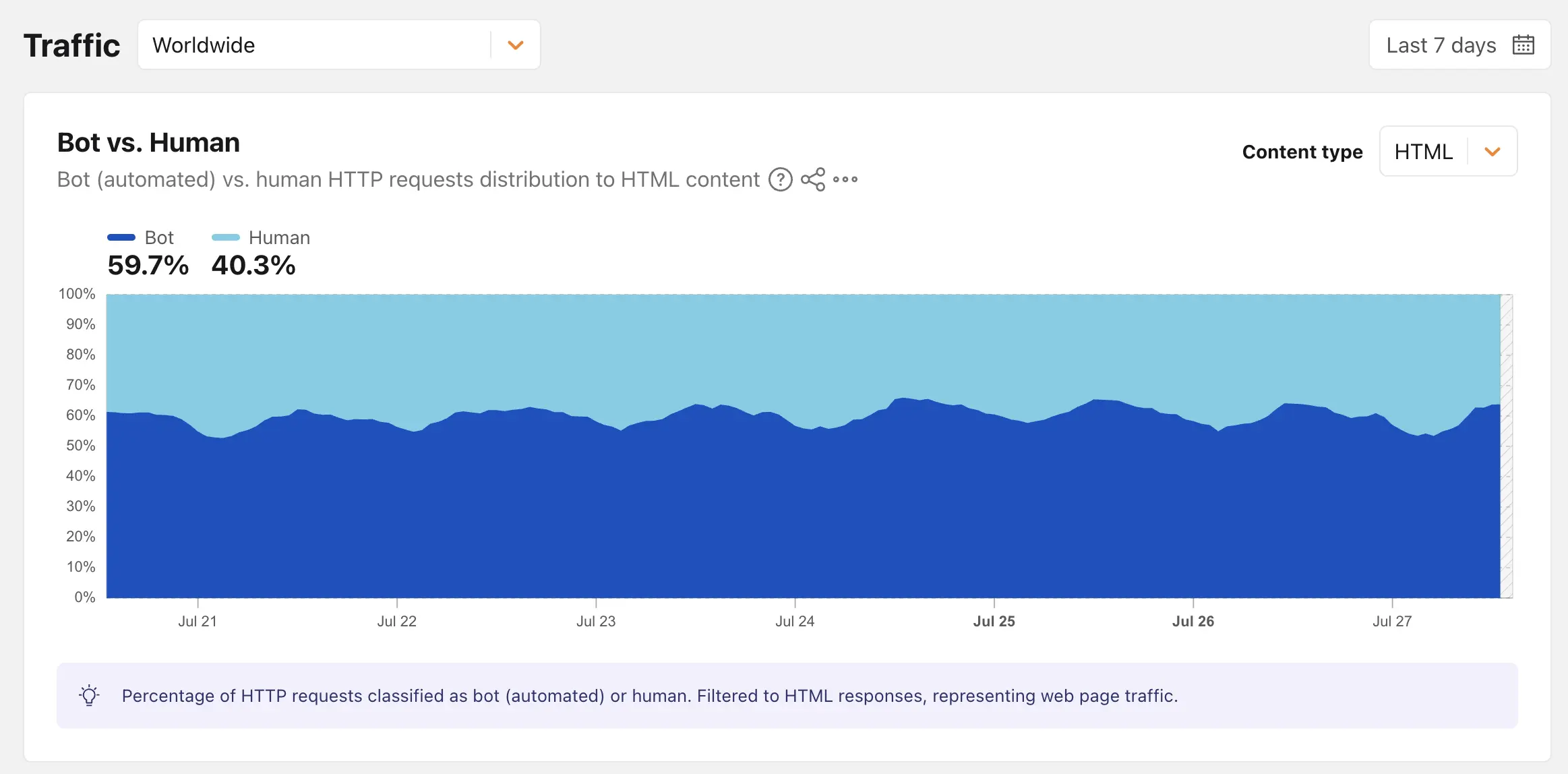
- The majority of web traffic isn’t coming from users—it’s coming from machines. Automated bots account for 59.7% of all HTML requests, while human visitors make up 40.3%. (Cloudflare, July 2026)
Most AI bots and AI agents can only read HTML
AI crawlers and agents rely heavily on clean HTML content and may miss information that requires advanced rendering or interaction.
- 46% of ChatGPT bot visits begin in reading mode, a plain HTML version of a webpage with no images, CSS, JavaScript, and schema markup. (Search Engine Land, October 2025)
- An analysis of 137k sites found that 97% of llms.txt files get zero visits. AI bots never look for llms.txt files. (Ahrefs, June 2026)
- AI only cites HTML pages and ignores Markdown (.md) pages. (OtterlyAI, April 2026)
- When someone asks for product pricing or specs, ChatGPT goes to the official brand page first. If it can’t access the page (e.g. due to JavaScript), ChatGPT will then scrape and quote third-party sites, which often leads to incorrect or outdated pricing. (Suganthan Mohanadasan, June 2026)
Concerns Surrounding AI Usage
While AI is helping us do everything faster, there are some concerns regarding hallucination, misinformation, and volatility in AI-generated answers.
LLM hallucinations and misinformation
AI models often generate incorrect information with confidence. Users still need to verify important answers, especially when decisions depend on accuracy.
- AI assistants hallucinate links nearly 3x more often than Google Search. ChatGPT is the biggest offender with 2.38% of all cited URLs returning a 404 error code. (Ahrefs, September 2025)
- AI Overviews give accurate answers 85%-91% of the time. That means 9%-15% of the time AI Overviews are inaccurate, so users should always double check the answers. (The New York Times, April 2026)
- AI Overviews are fully trustworthy only 39% of the time. (Oumi, April 2026)
- AI tools returned at least one false fact about 64% of UK high street retailers. (Searchable, July 2026)
Volatility and inconsistency in AI answers
AI responses are highly volatile. The same query can produce different answers, rankings, and cited sources depending on when and how it is asked.
This is the main challenge with AI visibility tracking.
- AI Overview content changes 70% of the time for the same query. And when it generates a new answer, 45.5% of citations get replaced with new ones. (Ahrefs, November)
- AI recommendations are highly inconsistent: there’s a <1 in 100 chance that ChatGPT or Google’s AI, if asked 100X, will give you the same list of brands in any two responses. (SparkToro, January 2026)
Americans worry about the negative impact of AI
Despite growing AI adoption, many people remain uncertain about its long-term effects. Concerns around accuracy, trust, and societal impact continue to shape public opinion.
- Among U.S. adults overall, 40% predict AI will negatively affect society in the next 20 years. (Pew via Search Engine Journal, June 2026)
- In contrast, far fewer expect a positive impact (16%), while 31% believe it will be equally positive and negative, and 13% are unsure. (Pew via Search Engine Journal, June 2026)
SEO is Evolving, But It’s Far from Dead
AI is the hottest thing at the moment, and no one can deny its huge impact on the way people search for information online.
But studies have shown that customers haven’t abandoned traditional search engines. AI isn’t replacing Google – it’s expanding search.
And since LLMs still need Google to access the world’s information, SEO remains essential.
The playbook may be changing, but the game is far from over.
Want to boost your visibility in both traditional and AI-driven search? Partner with an AI SEO agency today!